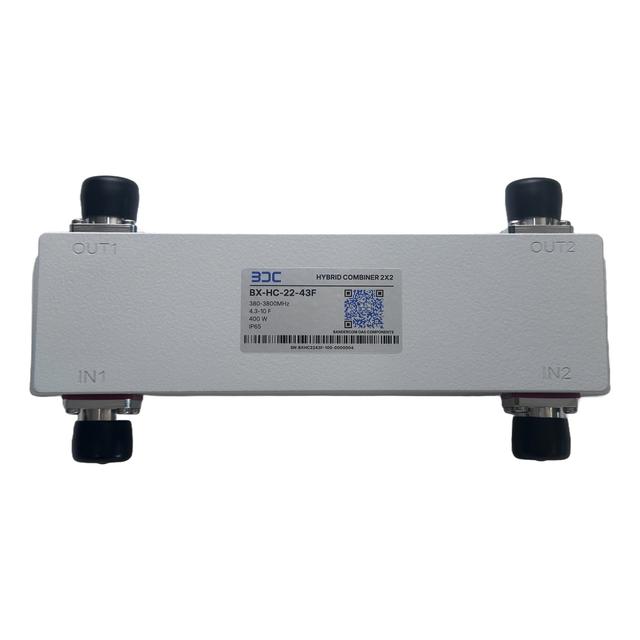
BX-HC-44-43F
Coming soon4×4 Hybrid Combiner
Four-input, four-output broadband hybrid combiner, frequency range 380–3800 MHz.
Datasheet rev. B · updated 6 November 2026
Specifications
| Performance | |
|---|---|
| Frequency range | 380–3800 MHz |
| Insertion loss | ≤ 8 dB 380–3800 MHz, incl. hybrid loss |
| Isolation | ≥ 28 dB 380–3800 MHz, port-to-port |
| VSWR | ≤ 1.25 · typ. 1.20 380–3800 MHz |
| Return Loss | ≥ 19 dB · typ. 21 dB 380–3800 MHz, all ports |
| PIM | ≤ −160 dBc · typ. −163 dBc IM3, 3rd order @ 900 MHz, 2 × 20 W |
| Impedance | 50 Ω |
| DC pass-through | Port 1 ↔ 5, Port 2 ↔ 7, Port 3 ↔ 6, Port 4 ↔ 8, max 6.5 A, AISG 2.0 conform |
| Total input power | 400 W Average |
| Mechanical | |
| Connectors | 4.3-10 Female (IEC 61169-54) |
| Dimensions (L × W × H) | 354.9 × 140 × 54 mm Without connectors |
| Weight | 3.5 kg |
| Colour | Grey |
| Mounting | Wall / Mast (brackets sold separately) |
| Environmental | |
| Ingress protection | IP65 |
| Operating temperature | -35 – 75 °C |
| Relative humidity | 95 % Non-condensing |
Selection and use
The 4×4 hybrid combines four sources onto four trunk lines. Insertion loss is at most 8.0 dB and isolation at least 28 dB. DC/AISG: input 1 → output 5, input 2 → output 7, input 3 → output 6, input 4 → output 8.
A hybrid combiner sits at the head end of a passive in-building network, in the equipment room between the signal sources and the trunk network. Its inputs take, for example, operators' base stations or repeaters and a public-safety or professional radio source, and its outputs feed the trunk lines to power splitters and tappers. The 380–3800 MHz range covers the TETRA bands (including VIRVE at 380–400 MHz), UHF professional radio up to 470 MHz, the 700, 800, 900, 1800, 2100 and 2600 MHz mobile bands and 5G band n78.
Guaranteed isolation means that a signal leaking into another source's port is attenuated by at least the stated value across the whole band. Isolation protects the sources from each other's power. The guaranteed PIM ≤ −160 dBc is measured with 2 × 20 W carriers at 900 MHz. The two-carrier test models the situation where the power of several networks passes through the same component.
If a hybrid output is not used, it is terminated with a load. The power of each input divides equally between all outputs, so an unused output receives half of the combined power of all sources in a 2×2 hybrid and a quarter in a 4×4 hybrid. Size the load's power rating accordingly.
A hybrid can also be used at a mast for antenna sharing. DC and AISG 2.0 control pass from each input to one specific output (max 6.5 A); DC does not reach the other outputs.